
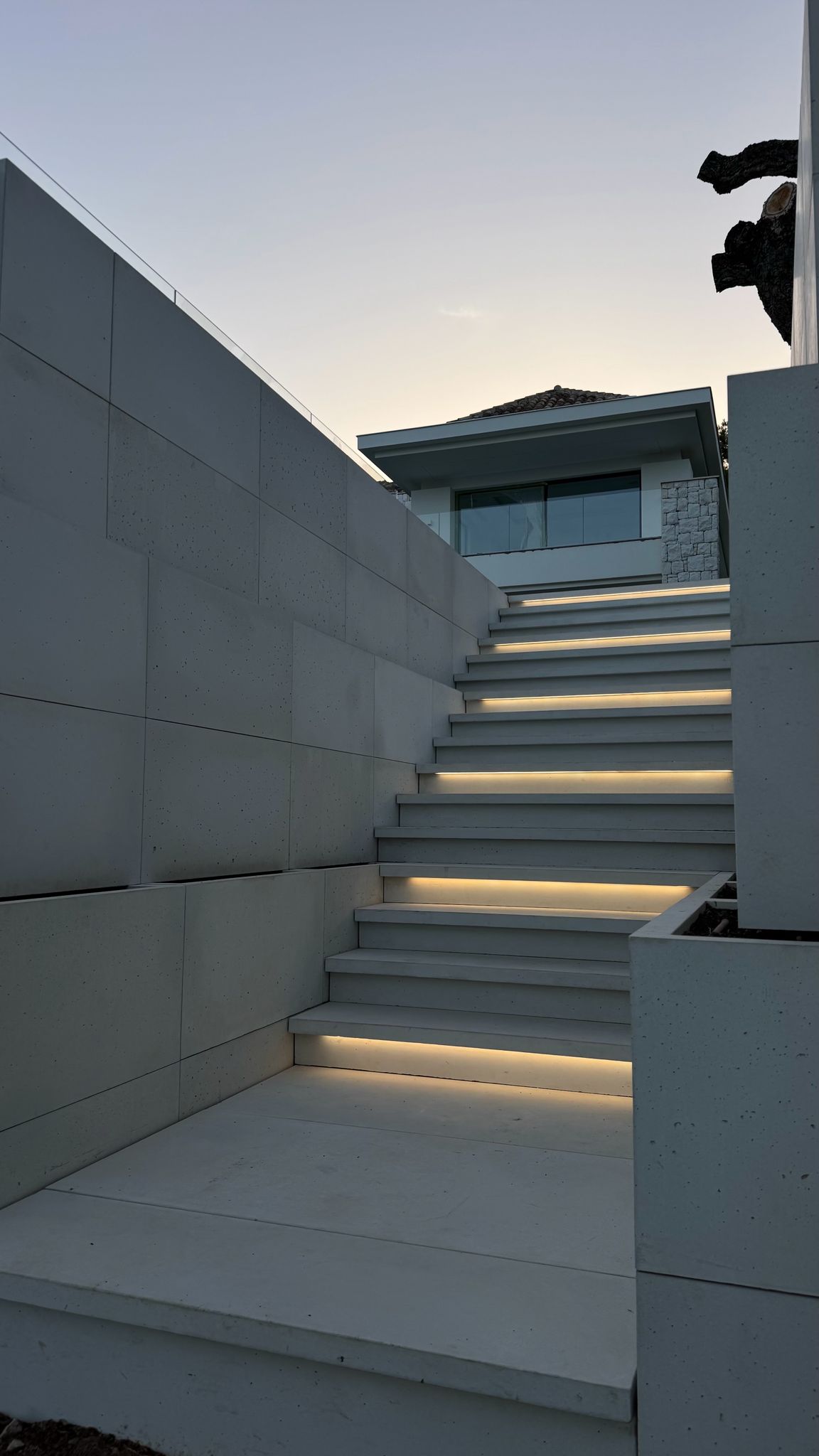
Modern construction is changing faster than ever before. Developers expect solutions that combine high-quality workmanship, shorter construction times and an aesthetic in keeping with contemporary architecture. One such solution is prefabricated concrete stairs, which are increasingly replacing traditional staircases built on site.
Prefabrication allows the production process to be carried out under controlled factory conditions, ensuring that each component is manufactured to a high standard of accuracy. This leaves only the precise assembly work to be carried out on site, which reduces the time taken and minimises the risk of errors.
In this article, we’ll explain why prefabricated concrete staircases are growing in popularity, describe the entire process – from design to installation – and showcase a project carried out by Maciejewski Concrete Works in a luxury development in Spain.
What are precast concrete stairs?
Prefabricated concrete staircases are components manufactured in advance at a production plant in accordance with technical drawings. The finished flights of stairs, or parts thereof, are then transported to the construction site and assembled using the appropriate equipment.
This solution is used, amongst other things, in:
- detached houses,
- apartment blocks,
- housing estates,
- hotels,
- office buildings,
- public facilities,
- high-end residences.
Prefabrication gives architects considerable design freedom and provides developers with the assurance that the finished element will comply with the documentation.
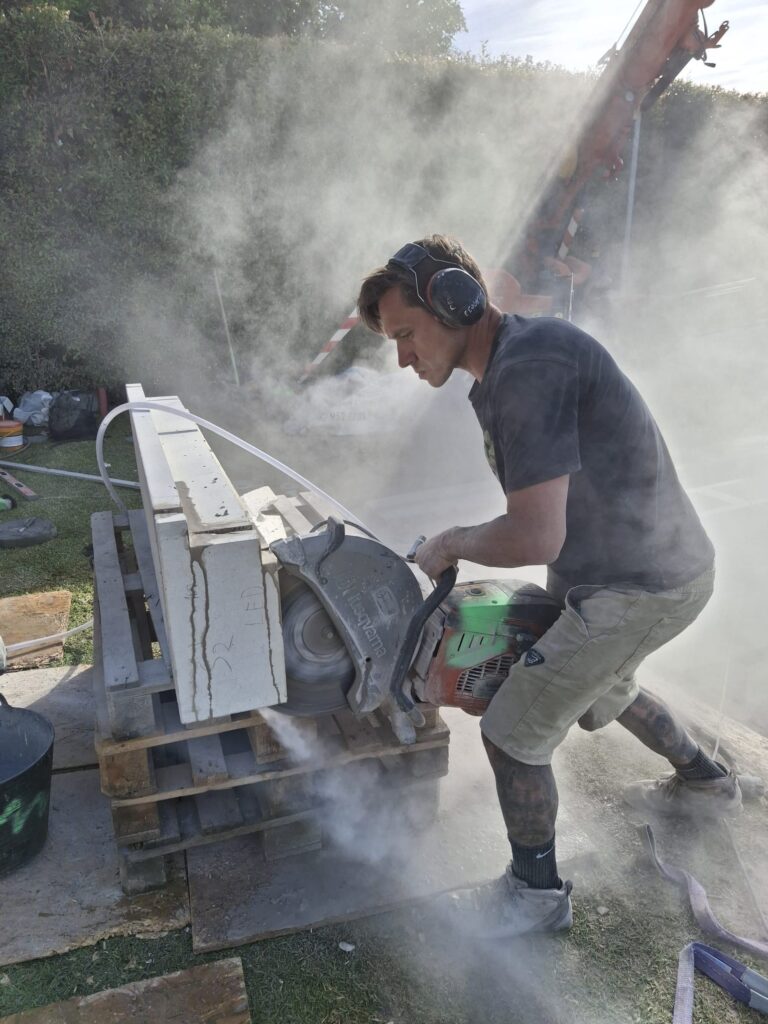
The precise fitting of prefabricated components during the assembly stage ensures that the stairs fit perfectly with the rest of the project. Each project requires a bespoke approach and careful supervision on site.
Why are investors increasingly opting for prefabricated concrete staircases?
The decision to use precast concrete stairs is not based solely on their aesthetic appeal. For investors, property developers and main contractors, timely completion, the predictability of the construction process and the durability of the solutions used are equally important.
Prefabrication allows most of the production work to be carried out at the factory, where the components are manufactured under controlled conditions. As a result, the stairs arrive on site ready for installation in accordance with the design documentation.
The main benefits of using precast concrete stairs are:
Shorter project completion time
Prefabricated components are installed in a much shorter time than stairs built traditionally on site. This helps to minimise downtime and speed up the subsequent stages of the work.
High-precision workmanship
Manufacturing under controlled conditions ensures a high level of dimensional accuracy and a high-quality finish. This is particularly important in modern projects, where every detail counts.
Consistent quality
Each component is manufactured in accordance with the technical design and is subject to quality control. This ensures that the client receives a solution that meets the design specifications.
Built to last for years
Prefabricated reinforced concrete stairs are characterised by high strength and resistance to heavy use and changing weather conditions, which is why they are used both inside and outside buildings.
The ability to carry out bespoke projects
Prefabrication does not mean being limited to standard solutions. Stairs can be designed to meet the specific requirements of a particular project, in terms of both dimensions and form or finish.
What is the process for installing precast concrete stairs?
Every project is different, which is why the manufacture and installation of precast concrete staircases require careful planning and close cooperation between the client, the designer and the contractor. A well-prepared process helps to avoid unnecessary delays, minimises the risk of errors and ensures that work on the building site runs smoothly.
1. Project analysis and preparation of documentation
The project begins with a detailed analysis of the architectural and structural designs. At this stage, the dimensions of the stairs, their foundation method and the technical solutions that will affect their subsequent installation are verified.
2. Production of prefabricated components
Once the design has been approved, production of the components begins. The stairs are manufactured under controlled conditions at the production facility, which ensures high-quality workmanship, dimensional accuracy and an attractive finish. Each component is produced in accordance with the technical documentation and undergoes quality control before being prepared for transport.
3. Transport to the project site
The prefabricated components are properly secured and transported to the building site. This stage requires careful logistical planning, as the size and weight of the components affect how they are loaded, transported and unloaded.
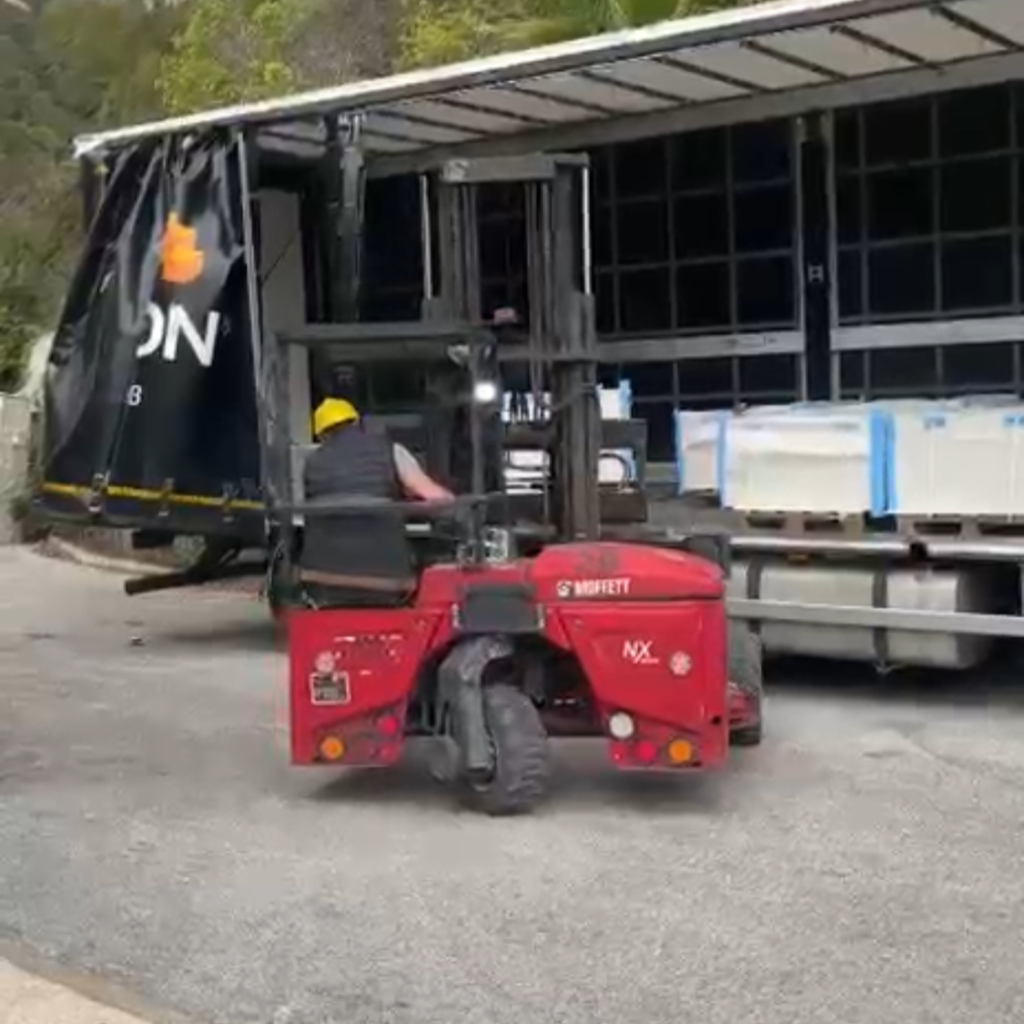
Unloading prefabricated concrete stairs at the building site prior to installation.
Case study – installation of precast concrete stairs in Spain
One of the projects carried out by Maciejewski Concrete Works The project involved the installation of prefabricated concrete staircases and street furniture in a modern residence located near Marbella in Spain. The project required precise planning, appropriate organisation of transport and the efficient execution of installation work whilst maintaining the highest quality standards.
As part of the project, prefabricated stairs made of architectural concrete were installed, and 160 prefabricated concrete planters fitted with an irrigation system. All the elements were designed as an integral part of the modern architecture and landscaping, which is why precision in execution and the aesthetics of every detail were of particular importance.
Logistics and project preparation
The project began with the careful planning of deliveries and the sequence of assembly for the prefabricated elements. Due to the size and weight of the components, transport and unloading required careful coordination to ensure that all prefabricated elements were delivered to the construction site on schedule and without risk of damage.
Precision assembly
Precast concrete staircases require very precise installation in accordance with the design documentation. During installation, each component was carefully fitted to the other parts of the structure, ensuring a perfect fit and maintaining the architectural intent of the design.
Specialised installation equipment was used for the project, which enabled the safe positioning of heavy prefabricated elements even in challenging terrain conditions.
The end result
The use of prefabricated concrete stairs has significantly streamlined the construction process and achieved a result that combines durability with modern aesthetics. The minimalist design of the stairs, architectural concrete, integrated lighting and prefabricated planters have created a cohesive space that fits perfectly with the character of this contemporary residence.
The project in Spain demonstrates that properly designed and professionally installed precast concrete elements are suitable not only for residential construction, but also for demanding projects with high architectural standards.
The most common mistakes made when installing precast concrete stairs
Precast concrete staircases can significantly reduce the time taken to complete a project and ensure a high standard of workmanship. However, to fully realise their potential, it is essential to plan the entire process carefully – from design, through transport, right through to installation. Even the best-made prefabricated elements require a professional approach at every stage of the project.
Below, we outline the most common mistakes that can affect the quality and timeliness of a project.
1. Inadequate project preparation
Every project should be preceded by a thorough analysis of the technical documentation. Errors in the dimensions or an incorrectly prepared sub-base may complicate installation and require additional work on site.
2. Poorly planned transport
Precast concrete staircases are large and heavy components, which is why their transport requires appropriate securing and carefully planned logistics. Incorrect loading or unloading can lead to damage to the components and delays in the project.
3. Lack of suitable installation equipment
The safe installation of prefabricated components requires the use of suitably selected lifting equipment and an experienced team. Choosing the wrong equipment may make it difficult to position the components precisely and increase the risk of damage.
4. Incorrect installation
Prefabricated staircases must be installed with great precision in accordance with the design documentation. Even minor deviations can affect their appearance, ease of use and the progress of subsequent finishing works.
5. Selection of a contractor based solely on price
The lowest price does not always mean the best solution. When it comes to precast concrete staircases, it is worth considering not only the cost of the project, but also the contractor’s experience, the quality of the materials used, adherence to deadlines and the scope of support offered. A well-planned and professionally executed project helps to avoid costly rectifications and ensures a long-lasting result for years to come.
„From the experience of Betony Maciejewscy”
Our experience shows that the success of a project depends not only on the quality of the prefabricated components, but above all on proper project preparation. A thorough analysis of the design, efficient logistics and an experienced installation team help to minimise the risk of errors and ensure the timely completion of even the most demanding projects.
Summary
Prefabricated concrete staircases are a modern solution that combines durability, aesthetic appeal and efficient project delivery. Thanks to production under controlled conditions and professional installation, they ensure a high standard of workmanship, reduce the time spent on site and guarantee long-term reliability.
An increasing number of investors, property developers, construction companies and architects are opting for prefabrication, not only because it saves time, but also because of the consistency of workmanship, safety and the ability to carry out even the most demanding projects.
W Maciejewski Concrete Works We believe that the success of any project is based on experience, precision and good organisation. That is why we offer a comprehensive installation service for precast concrete elements – from staircases and retaining walls to planters and other street furniture – carrying out projects both in Poland and abroad.
If you are planning a project using precast concrete elements and are looking for a partner to oversee every stage of the installation, please do get in touch. We will be happy to answer your questions, advise you on the best solutions and prepare a quote tailored to the specific requirements of your project.
The professional installation of precast concrete elements is an investment in durability, safety and aesthetics for many years to come.
Would you like to find out more?
If you are also interested in general information about precast concrete stairs, you may wish to read the article published by Murator, which discusses the basic principles of their design and application.

